Graphite vs Composite Pickleball Paddles – Complete Comparison
Do you go to the pickleball court and often have trouble with dinks that don’t land right, drives that feel weak, or just a strange feeling that something is off? The material on your paddle face might be the hidden reason holding you back, A paddle made from good material can help you get better at the game. Picking the right material for your paddle can change how you play, how well you control your shots, and how confident you feel in your game.
We tested many composite and graphite paddles on both indoor and outdoor courts. We used paddles from big-name brands and also from companies that make mid-level paddles. We did this so we could share real results that players at every level can trust.
In this article, we explain composite and graphite pickleball paddles in simple terms. We will start with how they are built and then talk about how well they work when you play for real. If you want more spin, better control over your shots, or the best paddle for your budget, this guide will help you pick the right one with full confidence. We will talk clearly about control, power, spin, how long the paddle lasts, the price, and what works best for players with different skill levels.
What’s Inside a Pickleball Paddle?
Before we look at how composite and graphite paddles compare, let’s quickly learn about the three main parts of any paddle. These parts all work together:
- Face
This is the part that hits the ball. It creates the biggest difference between composite and graphite paddles.
- Core
This part is usually made from a light honeycomb shape (polymer, Nomex, or sometimes aluminium). It controls the power, the bounce, and the volume of the paddle’s sound.
- Grip and Handle
These are important for comfort and control, especially in long matches that go on until evening.
The face material makes the real difference. A hard graphite face gives a fast, exact, and steady feel that high-level players like. On the other hand, a composite face that bends more easily (often made with layers of fibreglass) gives extra bounce, strong spin, and the power to soak up hard hits. This feels easier on your elbow and wrist.
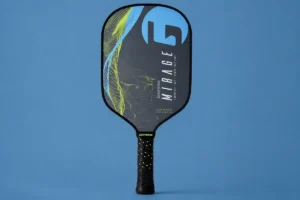
Graphite Pickleball Paddles
Graphite pickleball paddles are made from many thin layers of carbon fiber. These layers are pressed together under high heat and strong pressure. The process creates a hard, light paddle that delivers a quick, clear response on every shot. In our pickleball tests, one big strength of graphite paddles is their large sweet spot. It works the same way across most of the face. You still get a good result even if the ball does not hit right in the center. Many players and coaches notice the special “ping” sound. This sound builds confidence and energy during the game.
Graphite paddles shine in soft play. They work well for controlled dinks, third-shot drops, and gentle shots near the kitchen line. Advanced players and tournament participants often choose them. The paddles stay consistent even in long matches. They also help with fast reactions at the net.
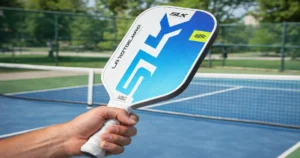
Composite Pickleball Paddles
Composite pickleball paddles usually have a face made of fiberglass and resin. This face sits atop a honeycomb core. The design gives the paddle a natural feel and a little flex. These paddles do more than add power. They are excellent at reducing vibration, which makes them easier on your arm. They are a smart choice if you want to avoid extra stress on your elbow or shoulder.
When the ball hits the paddle, you hear a “pop” sound and get extra bounce. This helps you add speed more easily, especially on drives, serves, and ground strokes. For this reason, many players see composite paddles as the best choice for strong baseline play. They quickly build your confidence. The paddles are also forgiving on hits that miss the centre. This helps new players and intermediate players make fewer mistakes.
Graphite vs Composite Pickleball Paddles Comparison
Here’s the simple side-by-side you’ve been looking for in the graphite vs composite pickleball paddle conversation:
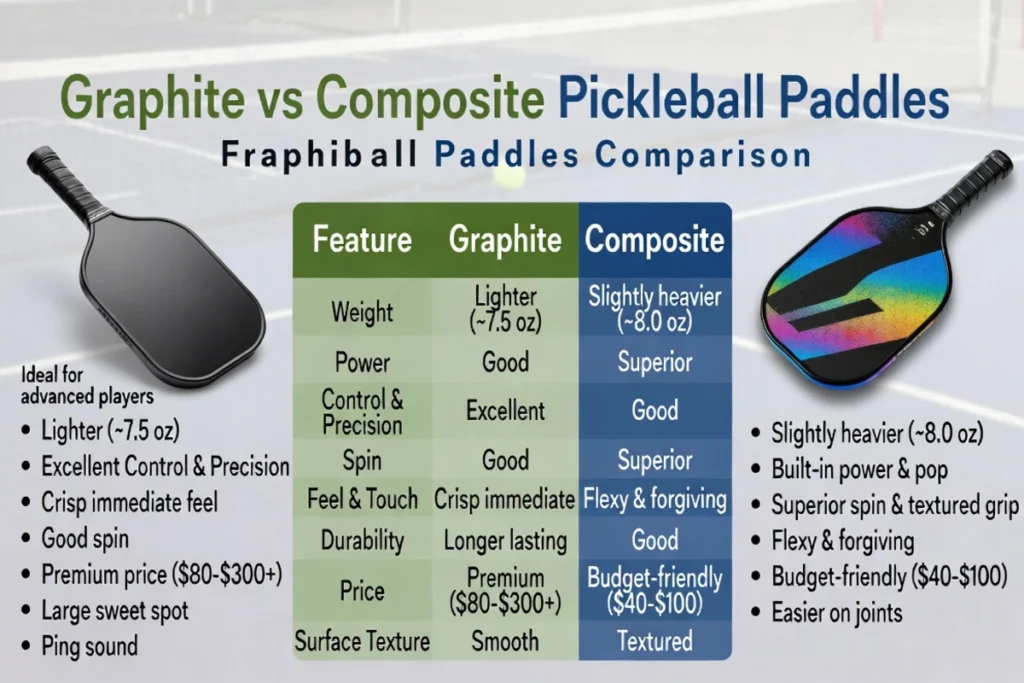
| Feature | Graphite Paddles | Composite Paddles |
| Weight | Lighter (~7.5 oz) – faster swings | Slightly heavier (~8.0 oz) – stable feel |
| Power | Needs your technique | Built-in pop and drive |
| Control & Precision | Excellent for placement | Balanced with extra forgiveness |
| Spin | Good, but less natural | Superior textured grip |
| Feel & Touch | Crisp and immediate | Flexible and forgiving |
| Durability | Often longer-lasting | Solid, but edges may wear faster |
| Price | Premium ($80–$300+) | Budget-friendly ($40–$100) |
| Surface Texture | Smoother – control king | Textured – spin machine |
This clear graphite vs composite pickleball paddles breakdown helps you see exactly what you’ll gain (and give up) with each choice.
Don’t Ignore the Core
The face material matters a lot, but the core matters just as much. It is the part that can make your paddle quieter, faster, or more powerful.
- Polymer Honeycomb: The most popular choice. It feels quiet and balanced.
- Nomex: This core is harder and reacts faster. It works great for players who want strong power.
- Aluminum Core: People use this type less often, and it gives you less control.
The right core can make your paddle feel even better and more like you. Pick the core that matches how you play. Then watch how your paddle changes. It will feel different, stronger, and truly yours.
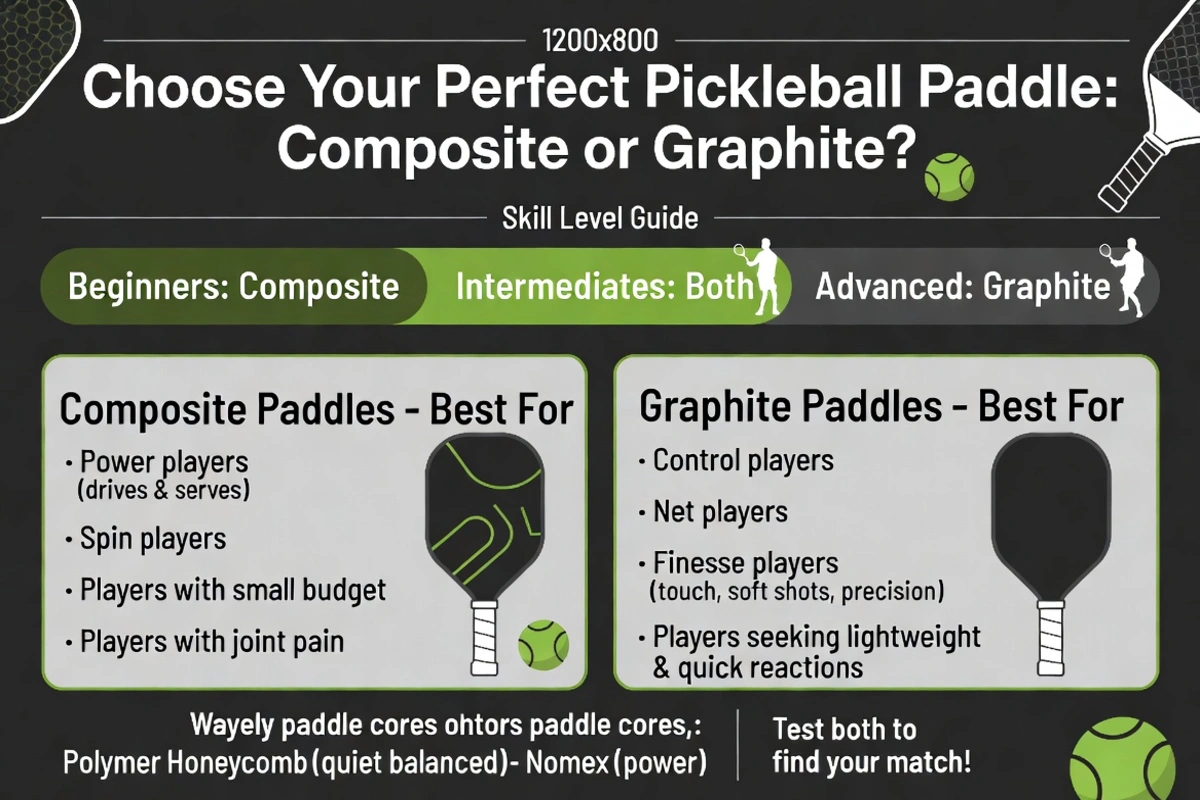
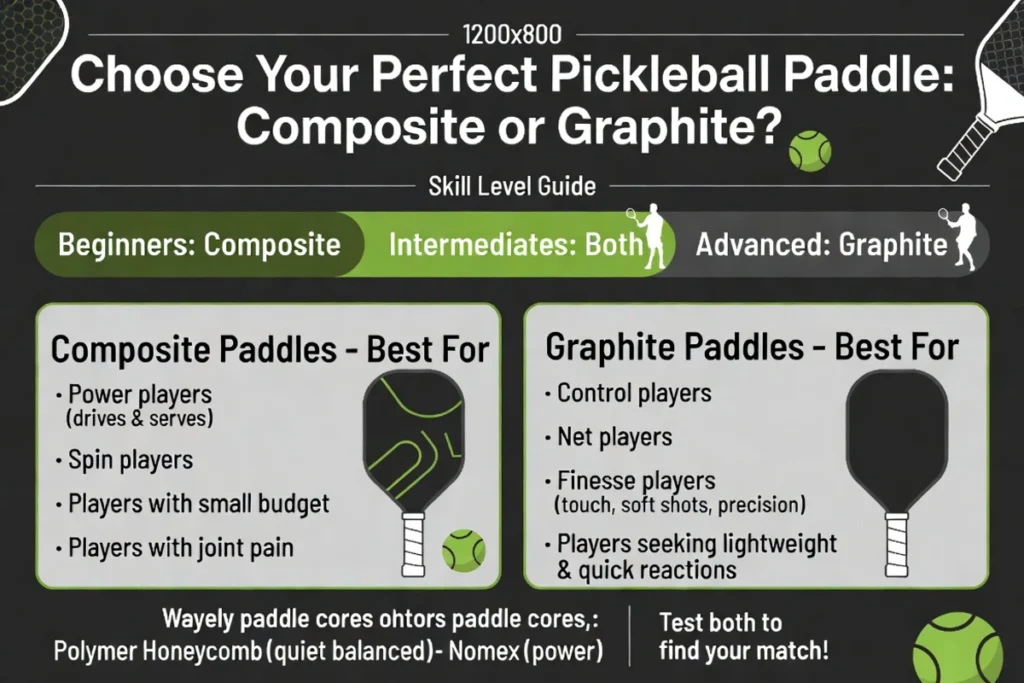
Which One Is Better for Your Level?
- If you are a beginner player, composite is the better choice.
- If you are an intermediate player, you can try both.
- Most advanced players prefer graphite.
Pick the Right One for How You Play
| Composite | Graphite |
| Power players | Control players |
| Spin players | Net players |
| Players with a small budget | Finesse players (touch, soft shots & precision) |
| Players with joint pain | Players seeking lightweight & quick reactions |
Composite and graphite are both modern materials that feel very close to each other. They give players a great mix of power and control.
Quick Price Guide
- Composite: Costs less and is easy to find
- Graphite: Costs more but gives better control
Final Note
Both graphite and composite paddles have their own good points. One gives you control. The other gives you power and spin. The best paddle is the one that fits your style and your budget. The best paddle is not always the most expensive.
You will only know the right choice after you go to the court and play. Head to the court, try both paddles, and see how they feel. Test them yourself. Then pick the one you like best.