
Pickleball Shots for Beginners: Groundstrokes vs Volleys Explained
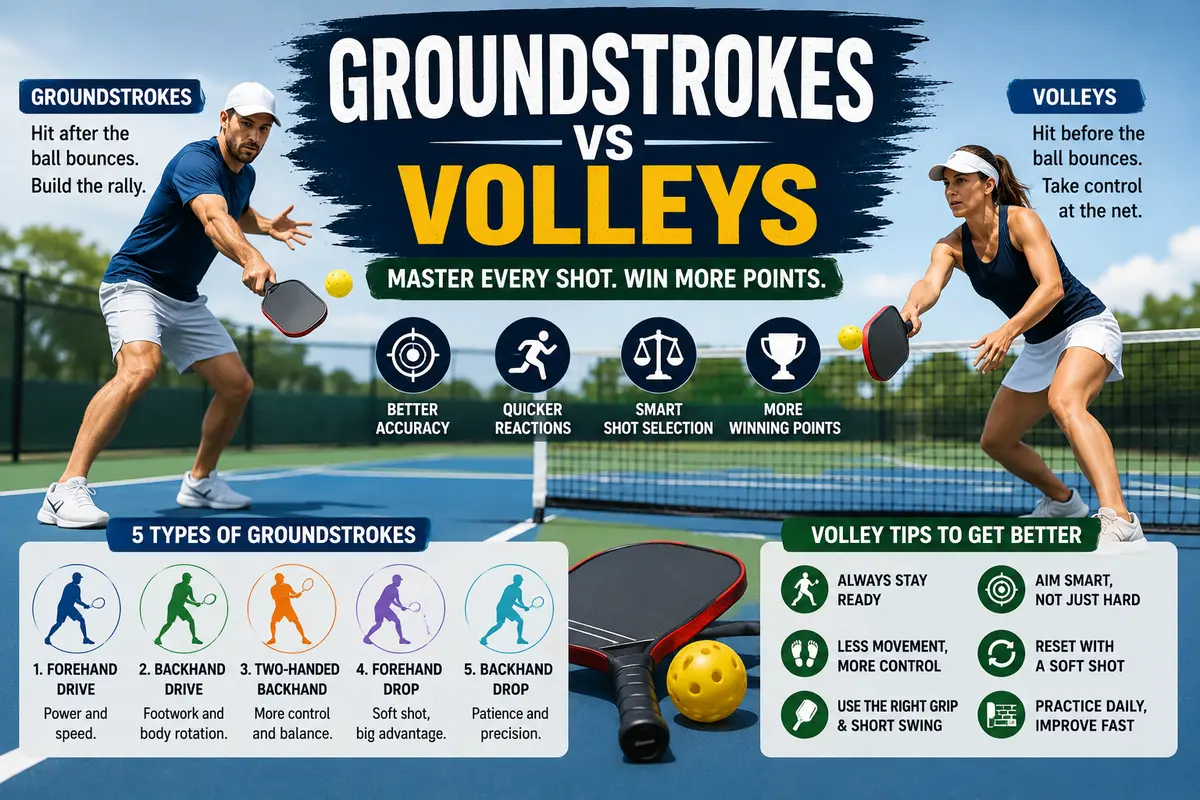
How many types of shots are there in pickleball? This is a question that new players often wonder about. Pickleball has quite a few shots, each with its own name, but there are two types of shots you can hit: groundstrokes and volleys.
Every player needs to understand both shot types because they help you improve your timing, court positioning, and shot selection. In this article, we’ll take a look at the difference between groundstrokes and volleys, their benefits, and the right ways to use them.
What Is a Groundstroke?
If you’re not scoring points in pickleball, the problem is with your shots. If you want to win more points, the first thing you need to understand is the groundstroke. It’s the basic shot that most rallies start with, and a strong game is built on it too.
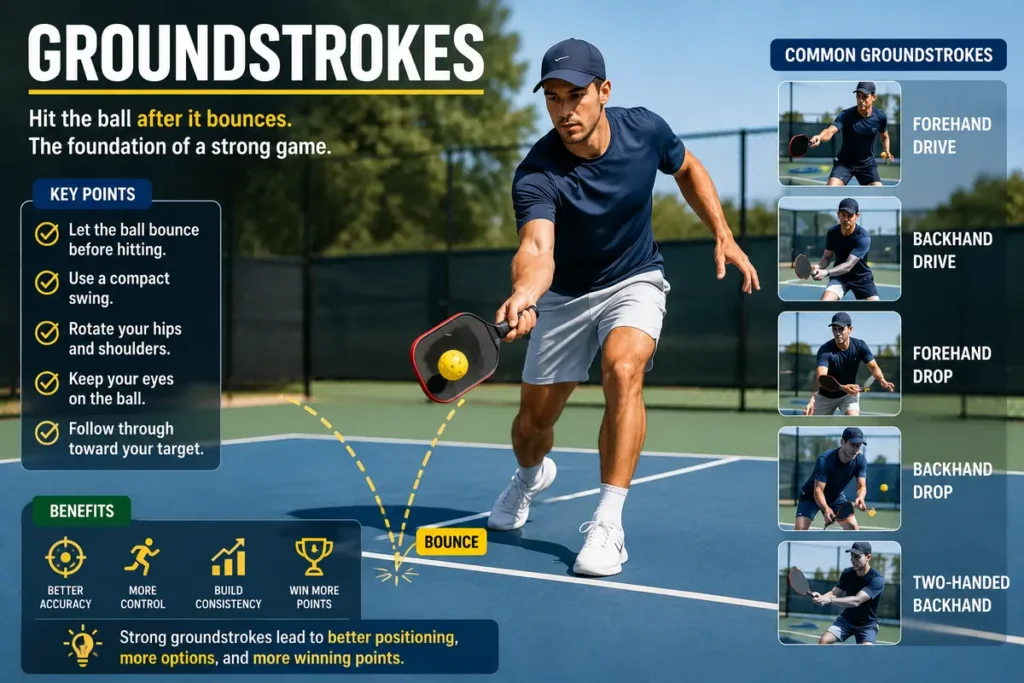
A groundstroke is a shot you hit after the ball bounces on the ground. It’s usually played from the backcourt or the baseline and is one of the core skills of the game. In fact, most rallies both start and continue with groundstrokes, so every player needs to master it. There are five main types of groundstrokes:
1. Forehand Drive
The forehand drive is the most common groundstroke in pickleball and also one of the most powerful. You hit it with your stronger hand, and the goal is to send the ball toward your opponent with enough speed that they don’t have much time to respond.
Why do beginners often miss this shot? Most beginners use only their arm to swing, and that’s what sends the ball out. A better approach is to rotate your shoulders and hips as you swing. This helps you hit with more power while keeping the ball in control.
This shot works best when the ball comes back up high after the bounce. That’s when you have the best chance to go for it with confidence.
2. Backhand Drive
The backhand is a tough shot for many beginners, but the shot itself usually isn’t the real problem. The issue is more about footwork and body position.
Most players don’t get into the right spot before swinging. They also skip the shoulder turn and try to force the shot with just their arm. That’s why it feels off and weak.
To improve it, focus on moving your feet first to get in front of the ball, then drive the shot using your whole body—not just your arm. With a little practice, your backhand will feel much more controlled and consistent.
3. Two-Handed Backhand
If the one-handed backhand feels too difficult right now, using both hands is a solid option. Many beginners find it much more manageable.
With both hands on the best paddle for beginners, you get better balance and more control over the shot. It’s a good place to start if you’re still building your skills.
Keep in mind, though, that reaching for wide balls is a bit harder with two hands. Good footwork helps a lot here—the closer you can get to the ball, the better your shot will be.
4. Forehand Drop
If you want to take your game to the next level, the forehand drop is a shot worth learning.
Many beginners go for power on every single ball. But experienced players know that a well-placed soft shot can sometimes be more effective than a hard one.
The forehand drop is all about landing the ball gently in the kitchen — the no-volley zone near the net. When you do this well, your opponent is forced to hit upward, which gives you an easier ball to hit back. It also gives you a chance to move closer to the net and take control of the point.
Keep your swing short and simple. Accuracy matters more than power here.
5. Backhand Drop
The backhand drop works the same way as the forehand drop. The only difference is that you play it from the backhand side.
Some players feel uneasy with this shot because they assume hitting soft on the backhand side is tricky. But if you get to the ball early and stay relaxed through the swing, it becomes a dependable shot over time.
With all drop shots, the key is patience and control—not how hard you hit.
3 Common Mistakes Beginners Make
Waiting for the Ball to Come to You
Some beginners stay in one spot and expect the ball to land right where they are. Instead, keep your feet moving and get yourself behind the ball before it arrives.
Taking Too Long to Prepare
The moment you see which way the ball is heading, start setting up your shot. If you wait too long, you’ll end up swinging in a hurry—and that usually leads to a mistake.
Using Full Power on Every Shot
Hitting hard all the time doesn’t always work in your favor. A controlled drop shot or a well-placed soft shot can put your opponent in a harder spot than a big, fast drive.
What Is a Volley Shot?
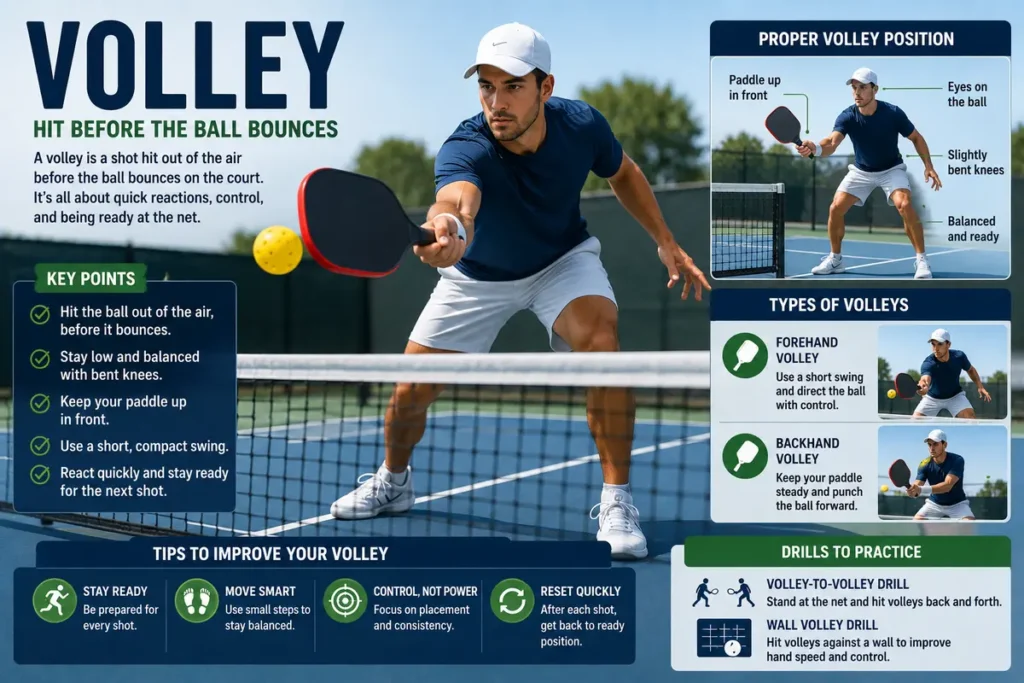
In pickleball, a volley is when you hit the ball out of the air—before it even touches the ground. You’ll mostly do this when you’re standing close to the net. The tricky part is that you barely have time to think. The ball comes at you fast, and you just have to go for it. That’s exactly why the volley is such a big deal in this game.
The whole point of a volley is to put your opponent on the spot and grab the point before they can settle in. Once a player gets comfortable at the net with their volleys, they’re really tough to go up against.
How Do You Get Faster at Volley?
Have you ever played someone who just keeps sending the ball back, no matter what you throw at them? You hit it hard, you mix it up—and they’re still there, calm and ready for the next one.
Here’s the thing, though—that’s not something you’re just born with. It’s something you build over time with the right practice.
A lot of beginners figure that if your hands are fast enough, you’re good. But that’s not really the whole story. What actually separates a solid volley player from the rest is how prepared they are, how steady they stay on their feet, and the choices they make in the moment.
Always Be Ready at the Net
A volley actually starts before you even swing. If you’re just standing straight up at the net with stiff knees, your reaction is going to be slow.
Try to keep your feet about shoulder-width apart, bend your knees just a little, and keep your body balanced. When you’re in that position, you can move in any direction a lot faster when the ball comes.
One mistake a lot of new players make is letting their paddle drop down after they hit a volley. Then when the next fastball comes—or the one after that—they’re already behind. After every shot, snap right back into your ready position and keep that paddle up in front of you. That one habit alone will make a big difference in how prepared you are for the next ball.
Less Movement and More Control
The more you move around at the net for no reason, the more your balance falls apart.
If you have to step to reach the ball, keep your steps small and controlled. Also, try not to move your head around too much. When your head stays still, it’s a lot easier to watch the ball and react to it in time.
And here’s something a lot of people don’t think about — fast volley exchanges are usually won with balance, not just with your hands.
The Right Grip and a Short Swing
A lot of new players keep switching their grip between forehand and backhand. In fast volleys, there’s just no time for that.
Find a grip that works comfortably for both forehand and backhand, and stick with it. You’ll react faster and keep much better control.
One more thing — the faster the ball is coming at you, the shorter your swing should be. Big swings usually end up missing the ball or popping it straight up. Against a hard drive, a firm, short block is honestly all you need.
Play Smart, Not Just Hard
When a fast volley exchange starts, a lot of players try to smash every single ball as hard as they can. And that’s usually the exact mistake that costs them the point.
Good players don’t go hunting for a winner on every shot. Instead, they just make things difficult for their opponent. A volley aimed at the middle, at the body, or close to the sideline often does more damage than a hard one.
And if you feel like your opponent is taking over the point, don’t try to force an attack. Just drop the ball softly into the kitchen and reset. That one smart call can save a whole lot of rallies.
The Easiest Way to Build Faster Reactions
If you really want to get better at volleys, don’t just rely on playing games — you need to drill specifically for it too.
Have one player hit drives from the back of the court while the other stands at the net and blocks them. Also do volley-to-volley drills at the net to sharpen your hand speed and control.
No practice partner? A wall works just as well. Practicing volleys against a wall for an hour every day can give you hundreds of extra reps in a single week. And those extra reps are what actually make the difference over time — in your reaction speed, your control, and your confidence.
Conclusion
In pickleball you can hit two types of shots. But playing well isn’t just about knowing both shots—it’s about knowing when to use them. Ground strokes are the base of your game, and volleys are your power at the net. Stay focused on control, accuracy, and consistency, and your game will get better on its own over time.
One Comment