
what is the kitchen in pickleball? – Complete Guide for Beginners
Do you know what the kitchen is in pickleball? There’s a small section on both sides of the net known as the kitchen. Its official name is the non-volley zone (NVZ), but the nickname “kitchen” makes it sound like just another ordinary spot on the court.
This article breaks down the rules and key points of the kitchen (non-volley zone). Understanding this zone matters at every skill level, from brand-new players to those looking to take their game up a notch.
The Basics
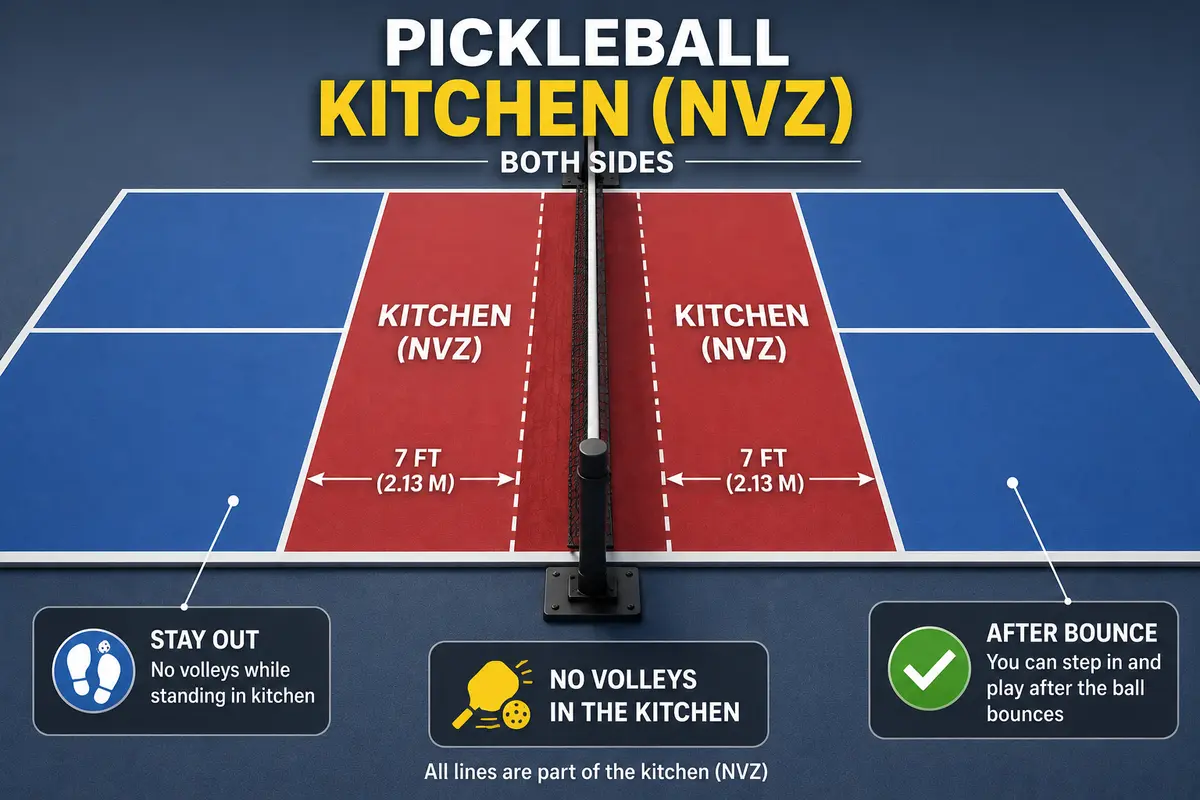
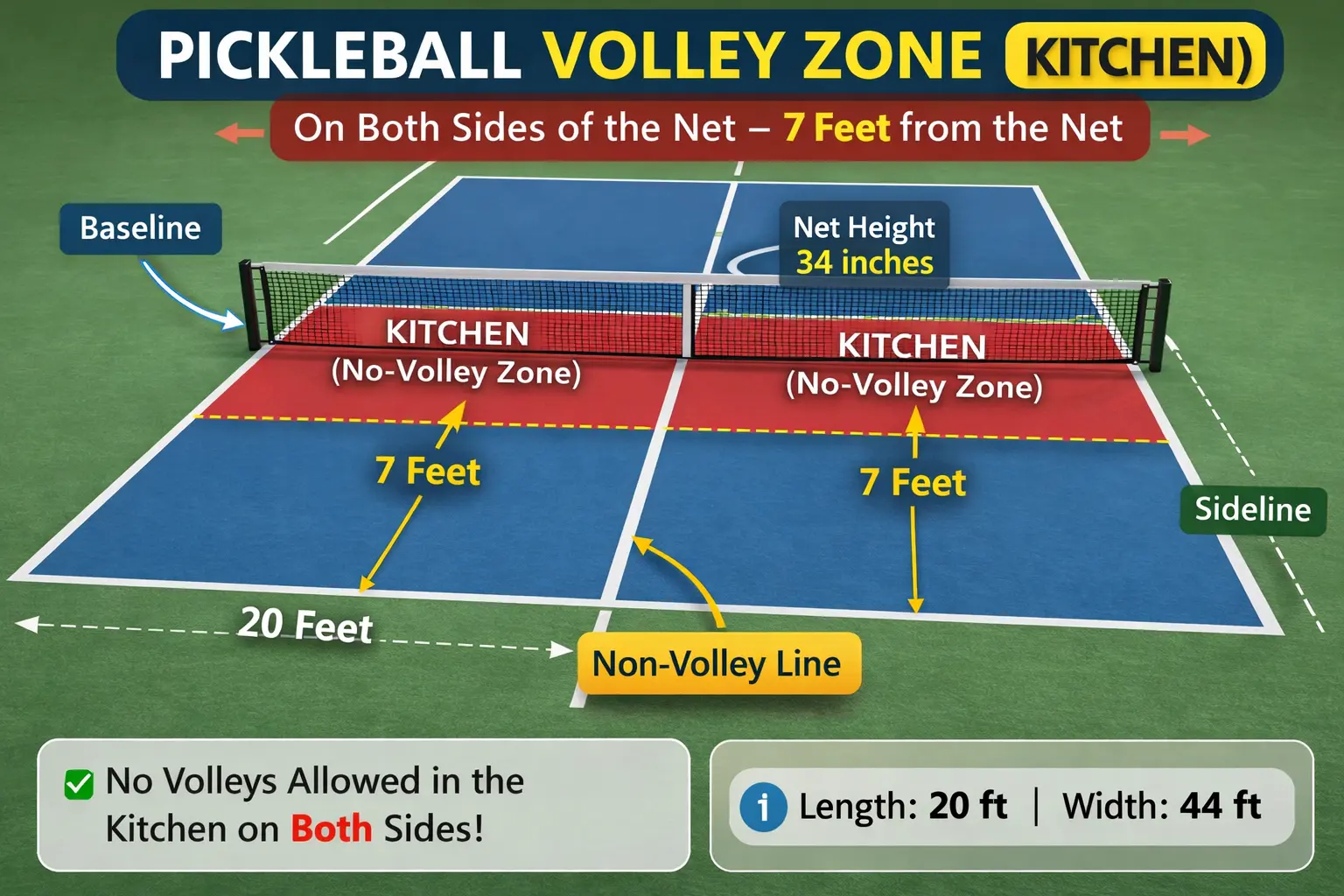
- The non-volley zone, or “kitchen,” extends 7 feet (2.13 meters) from the net on both sides and spans the full width of the court, 20 feet (6.10 meters).
- All lines marking this zone’s boundary count as part of the zone.
The kitchen sits right against the net, with a simple line marking its edge. Behind that line lies the rest of the court. The two-bounce rule requires that you meet it. Both the serve and the return must bounce once. Then, players can volley the ball.
What sets the kitchen apart is the restriction on how you can hit the ball inside it.
The Non-Volley Zone (Kitchen) Rule
A volley is any shot you hit before the ball bounces. You can’t hit a volley if your body, clothing, paddle, or anything else you’re holding touches the non-volley zone. The line count too; it’s treated as part of the zone.
This rule covers more than just the moment of contact. Your swing, follow-through, and momentum all fall under it. You can’t step into the zone or onto the line until your motion has fully stopped and your balance is back. Momentum carrying you into the zone still counts as a fault, even if the ball is already dead.
Standing in the kitchen pickleball is fine on its own. Just don’t volley while you’re there. Once the ball bounces, you’re free to step in and play the shot, and you can stay put afterward.
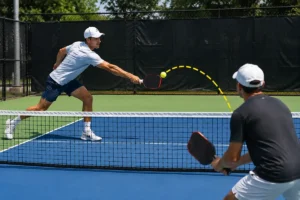
Leaning over the line or reaching your paddle or hand forward to volley is also legal. The only requirement: your feet and anything attached to your body, clothing and paddle included, stay fully out of the zone and off the line.
Kitchen Faults
The kitchen line is where players commonly slip up. Here’s where most players slip up:
- Stepping into the kitchen or touching the line while volleying the ball.
- Momentum carrying you into the kitchen right after a volley. This counts as a fault, regardless of whether the ball is already dead.
- Your paddle, clothing, cap, visor, sunglasses, watch, ring, bracelet, or any piece of jewelry brushing the zone during a volley.
- Jumping in from inside the kitchen to hit a volley and landing outside it. This still gets called a fault.
Partner contact counts too. If your partner is standing in the kitchen while you volley and you two touch each other, that’s a fault as well.
The line itself is part of the kitchen, so don’t forget that. Even a slight graze of your toe on the line during a volley gets flagged as a fault.
Read this article: Pickleball Shots for Beginners
Playing the Kitchen Line
In doubles pickleball, standing right at the kitchen line is the strongest position on the court. From here, you can:
- Volley the ball straight out of the air.
- Place shots smartly across the court and put your opponents in a bind.
- Keep the pressure on with solid, consistent shots until your opponents crack and miss.
This is where dinking comes into play. A dink is a soft, controlled shot that drops just over the net into your opponent’s kitchen, making it tough for them to attack. The goal here isn’t to win the point outright. It’s too drawn-out a mistake, so your opponent pops the ball up and hands you the attack.
Balance is everything. Stay patient while you dink, but the moment the ball pops up, switch gears and attack. Rushing and muscling every shot rarely pays off. Staying calm and waiting for your moment gives you better control of the point.
Beginner Players Mistakes
- Playing volleys while standing right on or too close to the line.
- Skipping the reset step after each shot, letting momentum drag players straight into the kitchen pickleball.
- Getting stuck in “no-man’s-land,” the middle-court zone between the baseline and the kitchen line that offers no real control and makes deep shots hard to handle.
- Swinging hard at every ball instead of waiting for the right moment and learning to drink.
Tips for Mastering the Kitchen
Work on your footwork for better control at the kitchen line, so you can stop right behind it and recover your stance after every shot.
Know when to step in, like after a strong third shot drop or a deep return, and when to take a step back, especially when the ball comes fast at your feet.
Don’t just react during a dink rally. Read your opponent’s paddle angle and body position, then anticipate the next shot before it happens.
Practice “touch and go”: step into the kitchen to play a bouncing ball, then pull both feet back out before your next shot.
Final Thought
Getting control of the kitchen line completely changes your game. Footwork gets tighter. Shot choices get smarter. And patience holds up when the pressure’s on. Stop handing out free points on kitchen faults, start winning the soft battles at the line, and watch your overall level climb fast.

9 Comments