How To Improve Pickleball Game – Top 10 Tips For Beginners
Just imagine: It’s the year 2010. Pickleball is spreading across the USA like wildfire, and there I stand on the edge of the court, paddle in hand, feeling like a stranger in a foreign land. I had absolutely no idea what I was doing. The grip felt awkward and unnatural, the “kitchen” (non-volley zone) looked as if it had “danger zone” written all over it, and every dink shot I tried to play either sailed long or ended up stuck in the net. I was a classic beginner player—I knew nothing at all. That’s why I felt frustrated and a little embarrassed, but deep in my heart, I was firmly determined to understand the game of pickleball.
Fifteen years later, after sweat-soaked hard work, thousands of matches, and countless lessons learned, I stand here today as a senior player. I, who once stumbled even in the basics, am now competing at a level I could never have imagined even in my dreams. This is not a story of overnight success. It is the real and difficult journey that every serious pickleball player must undertake. It is a journey that transforms confusion into confidence and raw talent into polished skill.
The growth of pickleball has been nothing short of explosive. A sport that was once merely a backyard pastime for families has now become one of the fastest-growing games in the world. It has drawn millions of people to the courts and created a vibrant community of male and female players of all ages. However, there is one reality that most new players fail to understand: rising popularity does not automatically guarantee improvement. You can play every day, but without a clear direction, you may remain stuck at the same beginner level.
That is why a structured approach is not just helpful—it is essential. Random, unstructured practice will only take you so far. Real progress comes when you understand the fundamental principles, build mental strength, and gradually adopt advanced strategies step by step. In this article, I am sharing the experiences from my fifteen-year pickleball journey—the complete guidance I wish I had back in 2010.
Whether you’re just learning how to grip the paddle the right way or you’re already winning local tournaments and looking to take your game to the next level, you’ll get practical, proven guidance right here. You’ll learn how to fix those common beginner mistakes, build a rock-solid foundation, sharpen your strategy, and—most importantly—fall even more in love with this fantastic sport.
If you want to take your pickleball to the advanced level, welcome! This article brings together all the key tips I followed to move from my own beginner journey all the way to advanced play. Let’s turn your court struggles into real skill and mastery.
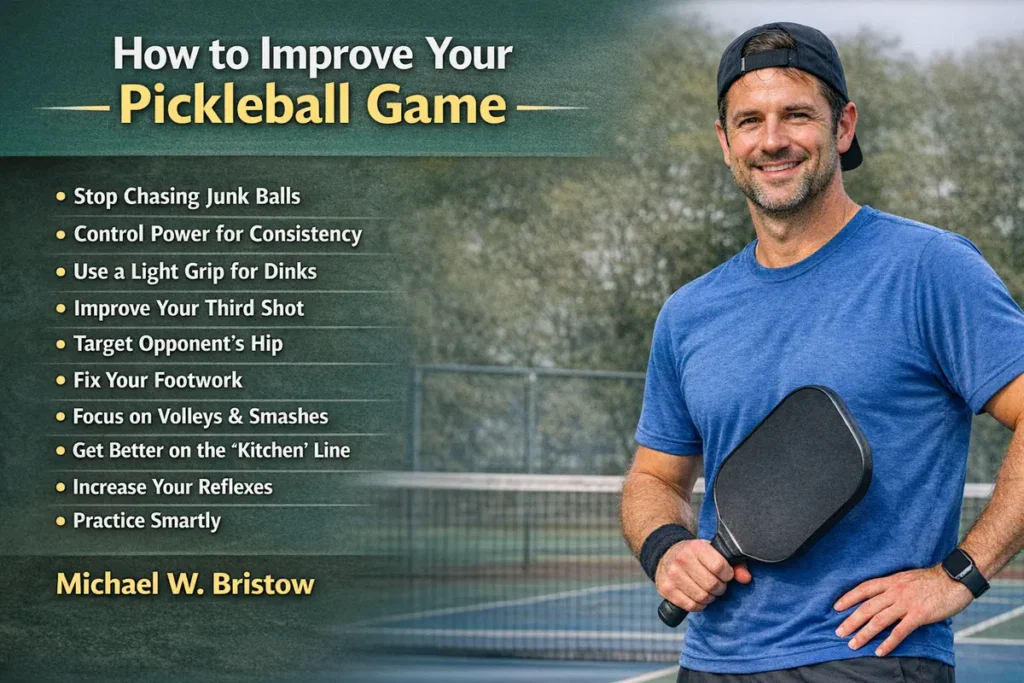
1. Stop Chasing Junk Balls
Early on, I made the classic rookie mistake of chasing down every drop shot my partner hit, no matter how ugly it looked. Half the time, the ball would pop up perfectly, just begging to be smashed, while I was still scrambling forward like a panicked chicken. I felt exposed, slow, and constantly out of position.
The fix came when I watched a breakdown of a high-level match: stop chasing the junk. Now I read the shot in real time. If my partner’s drop looks clean and deep, I glide forward with purpose. If it’s short, floaty, or headed for trouble, I stay planted in the transition zone, split-step, and reset. That single shift in awareness cut my unforced errors in half and let me arrive at the net balanced, ready, and in control—instead of late and lunging.
2. Control Power for Consistency
I used to crank every drive like I was auditioning for a highlight reel—full arm swing, maximum effort, zero control. Balls sailed out left and right. Opponents just smiled, reset easily, and I was gassed after three games.
Then I picked up a simple rule from the top coaches: swing at 70 percent power on purpose. The ball still dives before the baseline, but now it stays in. Drives became reliable weapons, serves gained spin without sailing long, and I saved my energy for the moments that actually mattered. That one mindset shift finally gave me the consistency I never had—and the confidence to go big only when the court opened up.
3. Use a Light Grip for Dinks
At first, I used to hold the paddle so tightly that it felt like it might fly out of my hands. The ball would bounce straight up, and my opponent would easily win the point.
Now I hold it very lightly—about 3 or 4 out of 10. The result is soft, low, and controlled dinks. This has become my best move on the court.
4. Improve Your Third Shot
For the longest time, my third shot was a weak, sliced high ball that handed opponents the chance to attack. I felt like I was giving them points on a silver platter.
The big improvement came when I learned to brush up through the ball with forward topspin. It clears the net with extra room, then drops sharply into their kitchen area. They have to hit up from their toes while I move forward and take the net first. This strong-soft drop mix—part drive, part soft landing—completely changed my move to the net. I am no longer just defending; I am in charge.
5. Target Opponent’s Hip
I wasted many shots aiming for the open court or “safe” spots. Opponents just stepped over and crushed them back at me.
Now I aim straight at their main-side hip—the exact spot where they hold the paddle. It forces an awkward chicken-wing swing, creates high balls, weak returns, and easy wins for me. Whether they are at the back line or the kitchen line, this one target turns confident opponents into hesitant ones. I smile every time I see that familiar pause.
6. Fix Your Footwork
Crossing over while running used to leave me off balance and late for every ball. I looked slow, felt slower, and covered only half the court I should have.
I practiced two simple habits: shuffle steps between shots and a super-quick split-step the instant my opponent hits the ball. Feet stay light and active, paddle stays high and ready. Suddenly, I am covering twice the ground with half the effort. The court feels smaller, my reactions feel faster, and I never get caught flat-footed again.
7. Read the Paddle Early
I used to guess where the ball was going and get beaten every rally. Eyes on the opponent’s face? That did nothing.
Instead, I lock onto their paddle face the moment they swing. Low paddle means they are hitting up—I stay high to block or attack. High paddle means they are hitting down—I drop low and get ready again. This one habit of looking ahead turns defense into quick offense. I stopped just reacting and started predicting, and the points started adding up in my favor.
8. Talk Constantly on Court
Early doubles felt like chaos. We left the middle wide open, ran into each other, and gave away easy points.
I started talking all the time: “Yours!” “Mine!” “Switch!” “Stay!” When my partner gets pulled wide, I slide into the L shape and guard the middle. We stack on the right side when it makes sense. Suddenly, we are locked in like a real team instead of two players guessing alone. The teamwork feels great—and opponents hate facing a pair that actually talks to each other.
9. Master the Soft Reset
Hard volleys at my feet used to end rallies in disaster. I would panic-swing and pop the ball straight up for an easy smash.
I learned the “shovel” move: a short, upward lift that guides the ball gently into their kitchen. No big backswing, just a soft scoop. It stops their attack, buys me time to step forward, and puts them right back on defense. This one defense skill has saved more rallies than all my winning shots put together.
10. Quick Paddle Recovery
I used to finish a big volley and freeze for half a second—paddle still high in the air—only to watch the next ball zip past me.
Now I snap my paddle back to ready position the instant the ball leaves my strings. Short, tight swings. Instant reload. I stay low and compact in the kitchen, ready for whatever comes next. Fights that used to overwhelm me now feel like my playground. Short points, big wins.
These ten changes did not happen overnight. I practiced some of them for weeks in the heat. Others clicked the moment I stopped trying to “look good” and started playing smart. But every single one moved me from just surviving rallies to owning them.
If you are reading this and feeling that same frustration on the court, know this: the better version of you that wins at pickleball is already inside. You just need the right guide.
Grab your paddle. Pick one tip this week and practice it until it feels natural. Then add the next. Before long, you will look back at your old self the way I do now—with a smile and a story to tell.
See you on the court. I will be the one moving smoothly in the middle area, paddle ready, waiting for that perfect moment to make the point look easy.
Who is ready to get better? Share your biggest struggle in the comments—I read every one and love helping other players improve. Let’s keep growing this game together.