How Much is a Padel Court? Full Cost Guide for Outdoor & Indoor Courts (2026)
If you’re also wondering how much it costs to build a padel court, you’re not alone. Today, thousands of people around the world are searching for the answer to this very question. Padel is an easy sport that’s quick to pick up for people of all ages, which is why it’s becoming popular so fast.
Perhaps you want to build a small court at home, or you’re thinking of starting a sports business. The good news is that if you get the right information first, you can avoid lots of mistakes and extra costs later on.
If you want to know the real cost of building a padel court, which sizes and types work best, and how you can get your own court up and running on a low budget, then this article will help you do exactly that.
How many types of padel courts are there?
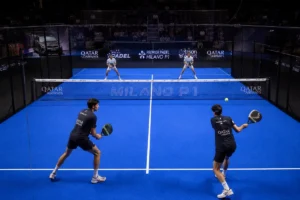
If you’re thinking about building a padel court, the first thing to understand is that not all padel courts are the same. Generally, there are two main types: outdoor padel courts and indoor padel courts. Both have their own advantages and disadvantages, and they’re designed differently, so choosing the right one is essential.
- Outdoor Padel Court
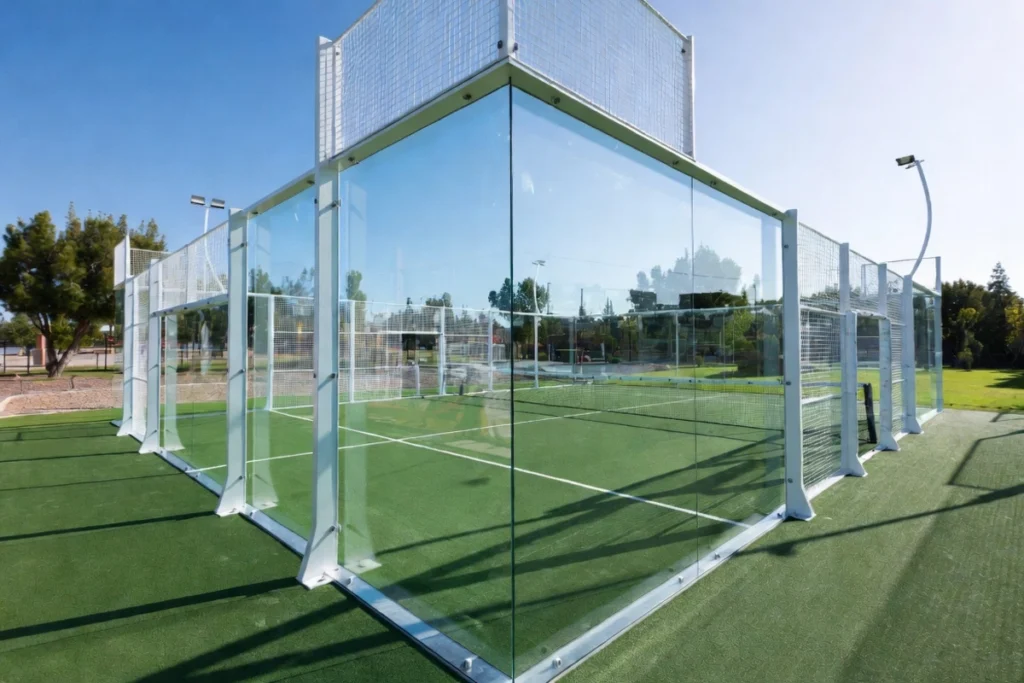
These courts are built in open spaces and are most commonly used in homes, parks, or open sports clubs.
Advantages
- Playing in natural light has its own special charm.
- They’re relatively cheaper to build.
- They’re a good choice for homes or small clubs.
Disadvantages
- They can be affected by rain, heat, and dust.
- They need more cleaning and maintenance.
If you want to get started on a smaller budget, an outdoor court could be a better option for you.
2. Indoor Padel Court
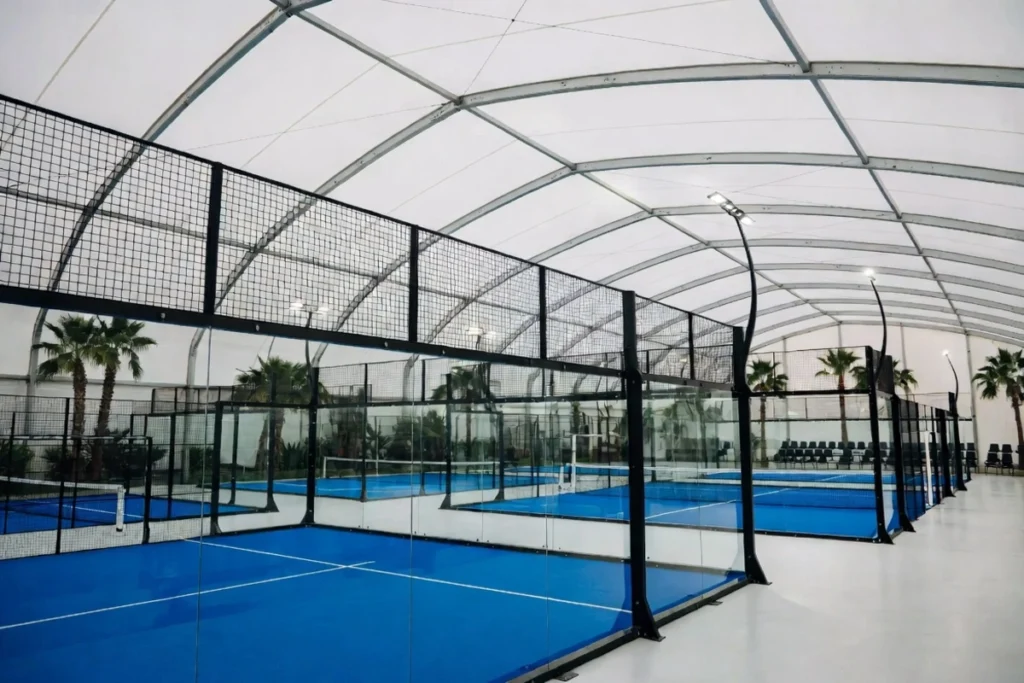
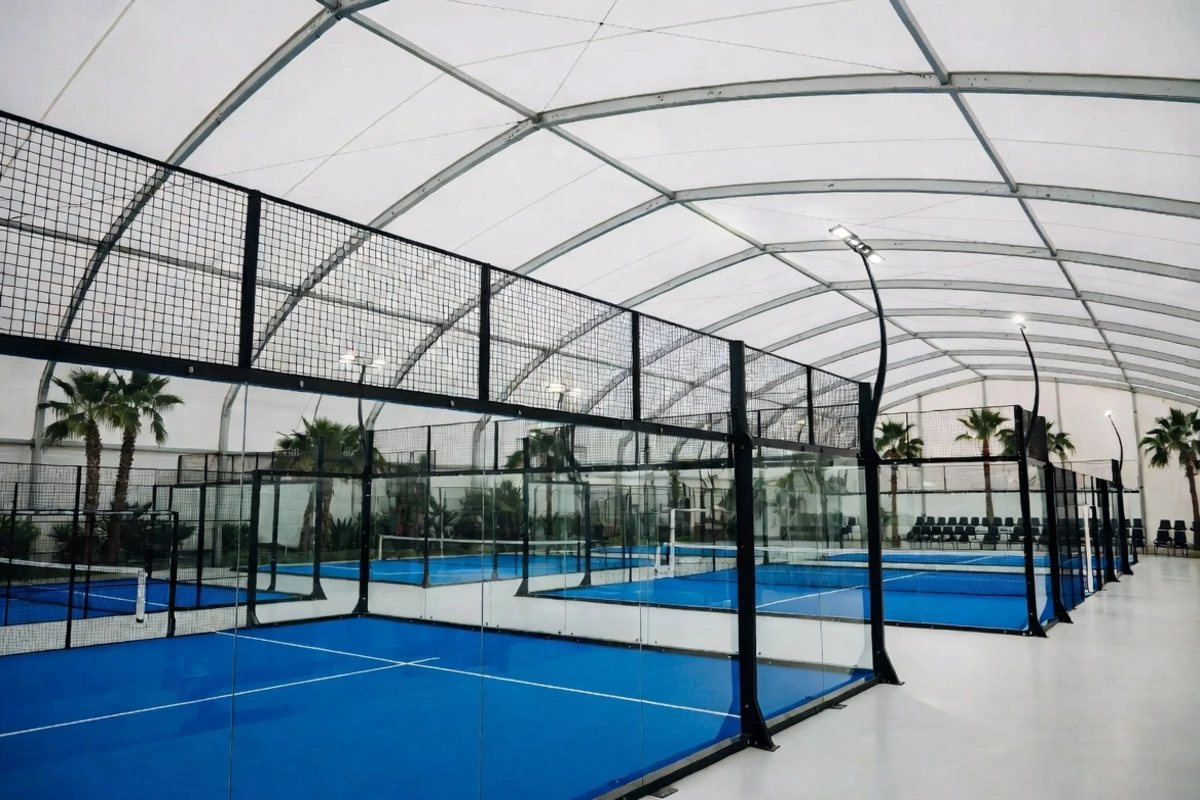
These courts are built inside an enclosed hall or shed, where the weather has much less impact.
Advantages
- You can play comfortably in any weather.
- They protect you from heat, rain, and strong winds.
- They’re more suitable for academies or businesses.
Disadvantages
- They cost more to build.
- They need plenty of space and good ventilation.
If you’re planning a long-term sports business or a premium club, an indoor padel court is likely the better choice.
The Three Most Popular Padel Court Designs
Right now, the padel industry is rapidly moving towards modern and premium designs. These days, people don’t just want somewhere to play – they prefer an environment with good lighting, beautiful surroundings, and comfortable settings. That’s why padel courts are no longer just playing fields; they’ve become modern sports and lifestyle spaces where design and overall atmosphere really matter.
Below are three modern, popular padel court designs used around the world. Each one offers its own special features, practical uses, and unique experience.
- Standard Design
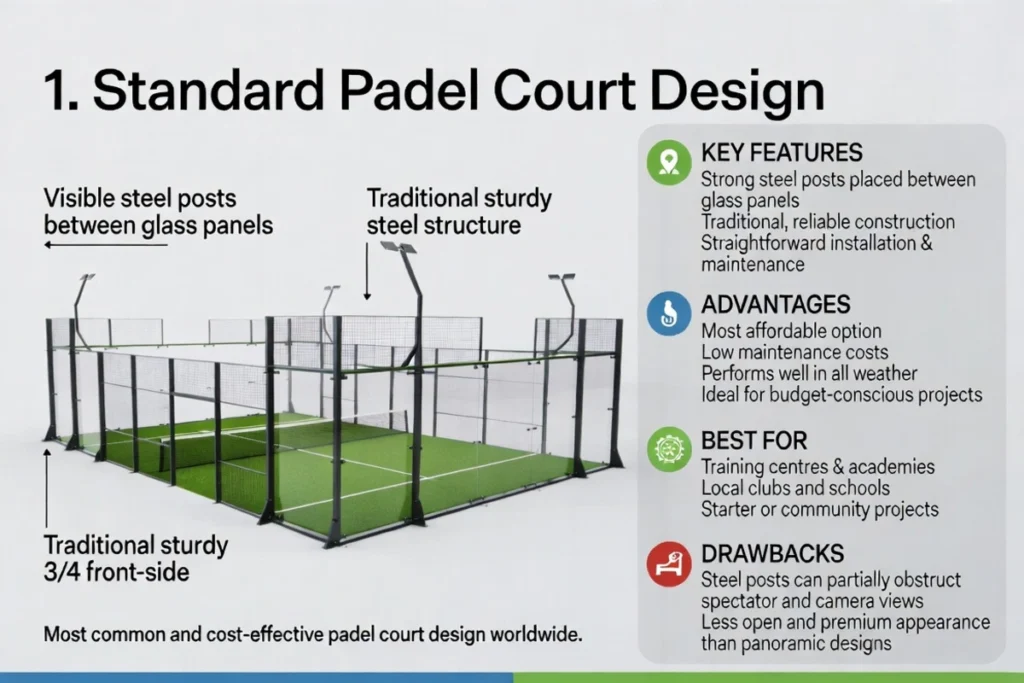
In the standard padel court design, strong steel posts are placed between the glass panels to support the entire structure. It’s a traditional, sturdy design and one of the most commonly used.
If you want to build a strong and reliable court on a limited budget, this is often a great choice. Installation is relatively straightforward, maintenance costs are low, and it performs well in all kinds of weather. That’s why new businesses and starter projects tend to go for it.
That said, the steel posts between the glass panels can sometimes partially block the view for spectators and cameras. As a result, the court doesn’t feel quite as open or premium as a panoramic design.
This design is mainly used in training centres, local clubs, schools, and similar projects where strength, durability, and budget matter more than looks.
- Panoramic Design
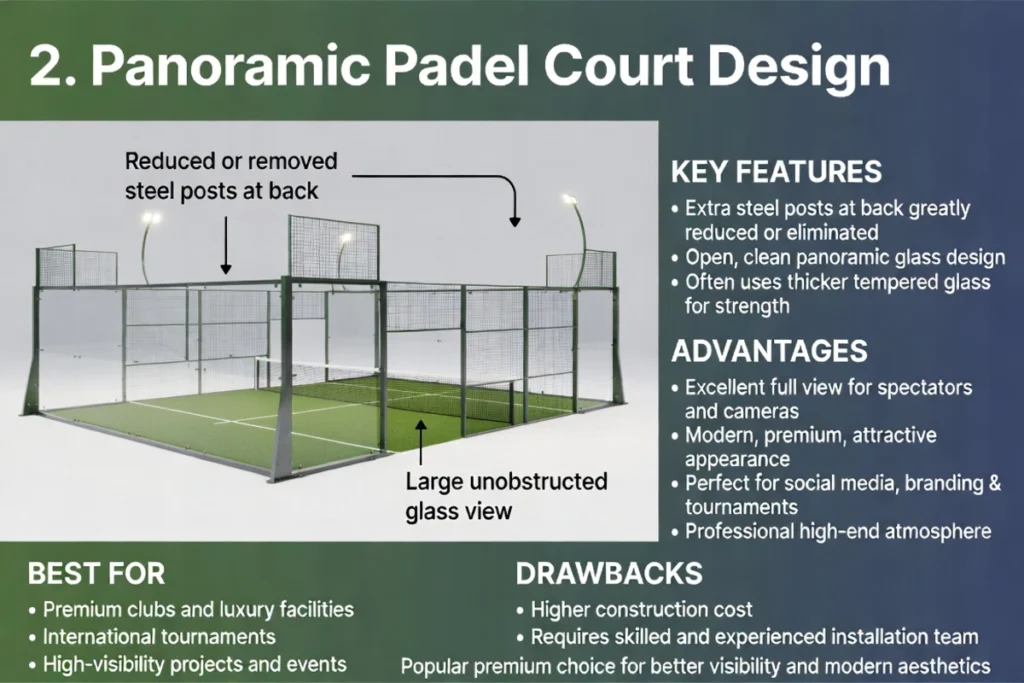
The panoramic padel court design is currently considered the most modern and premium. In this design, the extra steel posts at the back of the court are reduced or completely removed. This makes the entire court look much more open, clean, and attractive. The large, unobstructed glass view gives the court a professional look that impresses at first sight.
If you want a court that feels luxurious and instantly grabs people’s attention, this design is an excellent choice. It’s especially popular for social media videos, branding, and tournaments because the camera angles look much clearer and more premium.
Its biggest advantage is that spectators get a full, clear view of the game, making the whole atmosphere feel much more professional. However, this design costs more and requires a skilled team for installation to ensure the glass and structure stay completely safe and secure.
That’s why panoramic designs are mainly used in premium clubs, international tournaments, luxury sports centres, and high-end projects.
- Super Panoramic or Full Panoramic Design
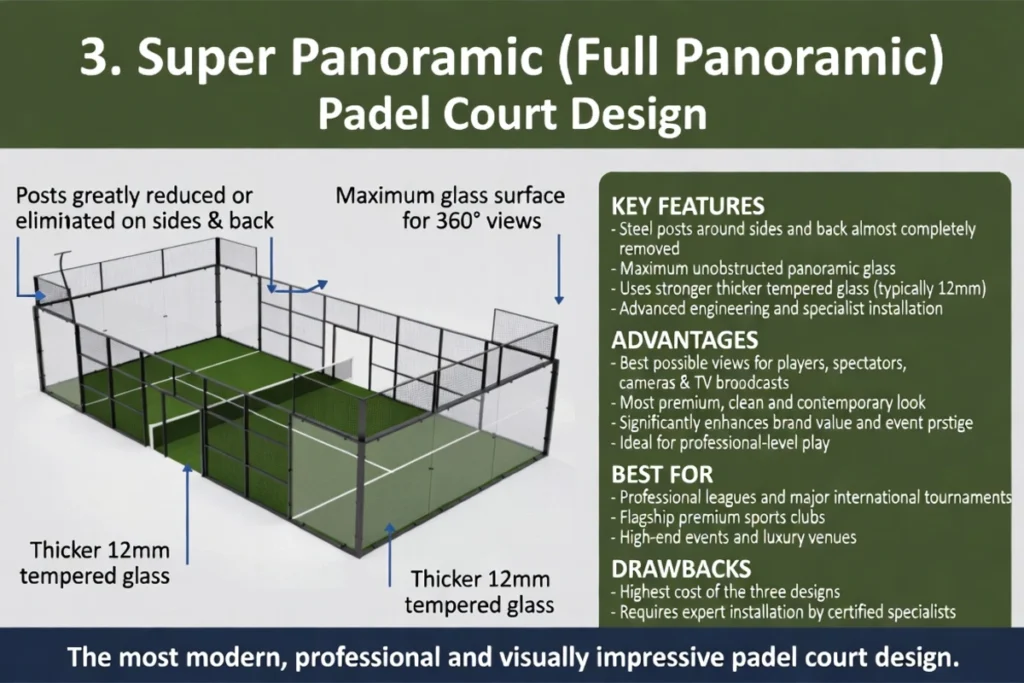
This is considered the most modern, attractive, and professional padel court design. In this design, the steel posts around the sides and back of the glass panels are greatly reduced or almost completely removed. As a result, the court looks much more open, clean, and contemporary.
Thicker and stronger tempered glass is usually used so the court stays safe, sturdy, and long-lasting. That’s why its construction and installation require a higher level of technical expertise.
This design is mainly used in international tournaments, professional leagues, premium sports clubs, and major events. It gives spectators, cameras, and broadcasters a much clearer and better view of the game. That’s why the court feels significantly more premium and helps improve the brand value of any sports project.
However, it costs more than the other designs, and because of the advanced engineering involved, installation must be carried out with extra care by experienced specialists.
Where Does the Real Cost Come From?
The price of a padel court isn’t decided by the glass and turf alone. The real cost comes from the things that make the court strong, safe, and built to last for years. The most important part is the steel structure, because it forms the foundation and gives the whole court its strength. If the steel is weak, problems will start appearing over time.
After that come the tempered glass, mesh system, artificial turf, LED lighting, and a solid foundation. In places like Britain and Europe, the drainage system is seen as especially important. If rainwater isn’t drained properly, it often leads to damaged turf, standing water, and disrupted play.
High-quality turf and 12mm tempered glass may feel expensive at the start, but they cut down on repeated repairs and maintenance costs later. That’s why simply going for the cheapest option often ends up costing more in the long run. It’s much better to focus on the strength and quality of the materials so the court stays in good condition for years.
According to rough estimates, a full outdoor padel court in the UK and Europe can usually be built for between £40,000 and £70,000, or €45,000 to €85,000. In ordinary towns and cities, the cost can even be a bit lower.
Building a padel court in the US and Canada is generally seen as more expensive. That’s because labour, land, permits, and construction costs are all higher there.
Costs in Australia are also quite high, especially for groundwork and installation. So building a padel court there usually works out more expensive than in Europe.
Factors That Increase the Price
The final price of a padel court is never the same across projects. If you build in London or another major European city, labour and installation costs rise quite a bit. Indoor courts are usually more expensive than outdoor ones, too, because they need a full structure, roof, ventilation, and extra lighting.
The panoramic design is another big reason prices go up, as it uses stronger and more expensive glass to create that open, modern look. Extras like VIP seating, branding, scoreboards, spectator areas, or premium lighting can also push the budget higher.
One interesting point is that building two or three courts together instead of just one usually brings the cost per court down. This is because expenses such as foundations, shipping, and installation can be shared across the courts, which makes the whole project more cost-effective.
Extra Costs That People Often Forget
Many people only focus on the basic price when they look at the budget for a padel court. In reality, several additional costs can push the total up quite a bit. For example, planning permission, local council approval fees, VAT or other taxes, shipping and freight charges, electrical work, and a proper drainage system are often overlooked at the start. Yet these are exactly the things that have a big impact on the court’s performance and how long it lasts.
Annual maintenance is another key expense many people overlook. It usually costs between €2,000 and €6,000 per year. This covers brushing the turf, refilling silica sand, cleaning the glass, and inspecting the structure. If you choose a good-quality installation and a strong drainage system from the beginning, you can cut these future costs considerably and keep the court in good condition for much longer.
How Much Can You Earn from a Padel Court?
These days, a padel court is no longer just a place to play – it has become a solid business opportunity too. In Europe and Britain, courts are often booked at €25 to €60 per hour, while in the US, rates can be even higher, often reaching $200 to $300 per hour. You can also earn good extra income from memberships, coaching, tournaments, and corporate events.
If the court is in a good location, is well-marketed, and offers quality facilities, most successful projects recover their investment in around 1.5 to 3 years.
Conclusion
In short, if a padel court is built with proper planning and sensible choices, it becomes much more than just a sports facility – it also turns into a strong and profitable business investment. Whether the goal is personal use or a commercial project, choosing quality materials, a proper drainage system, and professional installation will reduce problems and save you considerably on future extra costs.
The best decisions are the ones made after careful research rather than in a rush. Get quotes from several suppliers based on your location, budget, and needs, then compare them. With the right choice, a good padel court can give you years of play, enjoyment, and a solid return on investment.